
Introduction
If you’ve spent even a few weeks in the gym or on fitness Instagram pages, you’ve probably heard conflicting advice about whey protein timing and most of it sounds way more complicated than it needs to be.

Some people swear by chugging whey immediately after training, while others insist pre-workout protein is the real secret to muscle growth. Add in buzzwords like anabolic window and suddenly something as simple as drinking whey protein feels stressful.
The truth? timing matters but it’s far less important than the one factor that drives majority of the muscle growth, which we have clearly explained in this blog.
Table of Contents
Best Time to Take Whey Protein.
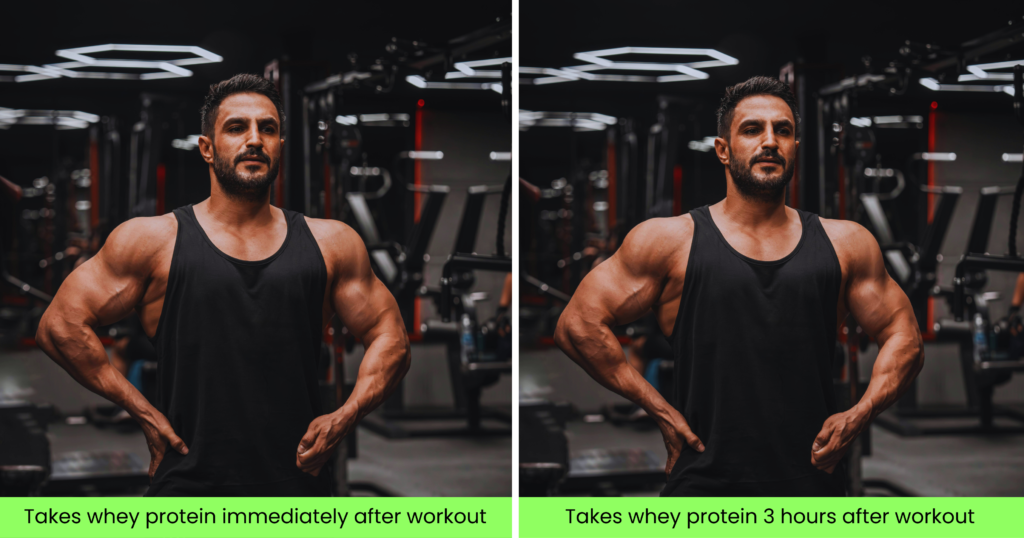
One guy takes whey protein immediately after his workout. Another guy takes the same whey protein three hours later.
Who do you think builds more muscle?
To answer this, researchers actually tested it in a controlled study. They took people who already lifted weights and put them on the same training program and the same high protein diet. Both groups ate enough protein every day. The only difference was timing.
- Group 1: Took protein right before and right after training
- Group 2: Took protein three hours before and three hours after training
After several weeks, researchers measured muscle growth and strength. The result was simple: both groups gained the same amount of muscle and strength.
It means that as long as you’re eating enough protein across the day, your muscles don’t care much about whether whey is taken immediately after training or a few hours later. Muscle growth depends more on total daily protein intake than perfect timing.
So instead of worrying about racing to your shaker bottle, focus on hitting your daily protein goal. Take whey protein before or after your workout as per your convenience.
Why Total Daily Protein Matters More Than Timing?
Muscle growth doesn’t happen at one exact moment, it happens over time. Every time you train, your body increases muscle protein synthesis (MPS) for several hours, and in some cases even up to a full day. During this period, your muscles use protein to repair and grow stronger.
This is why total daily protein intake matters more than exact timing. If you consistently provide your body with enough protein across the day, your muscles have a steady supply of amino acids whenever MPS is active. In contrast, perfectly timing a shake won’t help much if your overall protein intake is low.
Think of it this way: Protein timing is like showing up to the gym at the “perfect” hour once.
Total daily protein is like training consistently every week. Results come from consistency, not perfect timing.
On the other hand, missing your daily protein target, even if you hit the “anabolic window,” will slow muscle growth.
What Is Whey Protein and Why Is It So Effective?

What Is Whey Protein?
Whey protein is a high quality protein derived from milk during the cheese making process. When milk separates, it forms curds (casein) and liquid whey. That liquid is filtered, dried, and processed into the powder which most lifters use today as whey protein.
Depending on processing, whey comes mainly in three forms:
- Whey concentrate: contains 70–80% protein, with small amounts of fats and carbohydrates (including lactose). It’s less processed, more affordable, and works well for most beginners.
- Whey isolate: Usually provides 85–90% protein with minimal fats and lactose due to extra filtration. Ideal for fat loss phases or for those with mild lactose sensitivity.
- Whey hydrolysate: Contains around 80–90% protein and is partially pre-digested for faster absorption.
Why Is It so Effective?
Whey protein is effective not because it’s trendy, but because it aligns perfectly with how muscle growth actually works in the body.
First, whey is a complete protein, meaning it contains all nine essential amino acids that your body cannot produce on its own. These amino acids are non-negotiable for muscle repair and growth, and missing even one can limit muscle protein synthesis. Whey ensures that limitation never becomes a problem.
Second, whey is especially rich in leucine, the amino acid that acts as a trigger for muscle protein synthesis. Research shows that reaching a leucine “threshold” is key to stimulating muscle growth after training, and whey naturally hits that threshold more efficiently than most whole food protein sources.
How Muscle Growth Actually Works (Simplified Science).
Muscle growth isn’t complicated it’s just gets overexplained. At a basic level, muscles grow when you train them, feed them enough protein, and give them time to recover.
When you lift weights, you create small amounts of stress and damage in your muscle fibers. Your body responds by repairing that damage and building the muscle back slightly stronger. This process is called muscle protein synthesis.
Protein plays a key role here because it provides amino acids, which are the building blocks your body uses to repair and grow muscle. If you don’t eat enough protein, recovery slows down and muscle growth is limited no matter how hard you train.
The Concept of the “Anabolic Window”
The anabolic window is the idea that right after a workout, your muscles enter a short period where they’re primed for growth and if you don’t eat protein quickly, you miss out on gains.
This concept came from early research showing that muscle protein synthesis increases after resistance training. Because muscles were more responsive to nutrients post workout, people assumed this window was very short often described as 30 minutes.
But here’s where the misunderstanding happened.
Later studies showed that muscle protein synthesis doesn’t spike for just a few minutes. It stays elevated for many hours after training, sometimes even up to a full day. That means the “window” isn’t a tiny crack that slams shut it’s more like a wide door that stays open.
Conclusion
Whey protein isn’t a medicine that only works at a specific time, it’s a supplement meant to help you meet your daily protein needs. Whether you take it before or after your workout matters far less than consistently hitting your total protein intake daily.
So instead of stressing about perfect timing, use whey in a way that fits your routine and diet. When consistency is right, muscle growth takes care of itself.
Frequently Asked Questions (FAQ)
Q1: Is it necessary to take whey protein immediately after a workout?
No, while it’s convenient, studies show muscle growth is similar even if protein is taken a few hours later as long as daily protein intake is adequate.
Q2: Can I take whey protein before my workout instead of after?
Yes, pre-workout whey can work just as well, especially if you haven’t eaten protein for several hours before training.
Q3: Is whey protein mandatory for building muscle?
No, you can build muscle with whole foods alone.
Q4: Can I take whey protein on rest days?
Yes, protein supports recovery and muscle repair even on non-training days.